
Vos* Del Sur: Central American Studies from the Global/U.S. South
By Alejandra Mejia
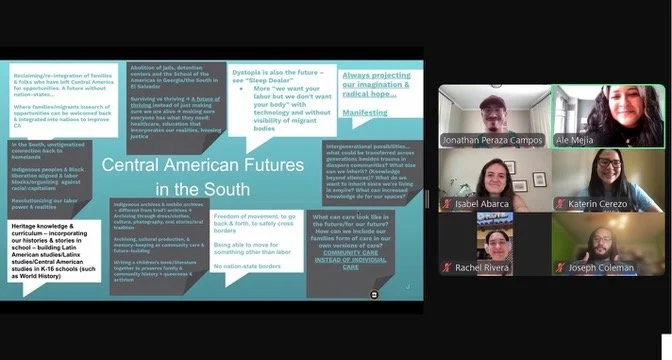
From September 2024 to June 2025, Teaching Central America program specialist Jonathan Peraza Campos and I taught an independent ethnic studies and political education class entitled, "Vos* del Sur: Central American Studies from the Global/U.S. South."
The class was hosted as a project of Migrant Roots Media, an independent media organization which publishes content by migrants and children of migrants unearthing the root causes of global migration. The title of the course is a play on words on the common Central American pronoun "vos" (meaning "you") and the word "voz" (meaning "voice"), thus conveying the sentiment "You from the South" and "Voice from the South."
Besides Jonathan and me, the class was composed of six brilliant participants from diverse backgrounds, but what united all of us was being Central Americans who were either born, grew up, and/or currently reside in the U.S. Southeast, as defined by the states of Alabama, Arkansas, Florida, Georgia, Kentucky, Louisiana, Mississippi, North Carolina, Oklahoma, South Carolina, Tennessee, Texas, Virginia, and West Virginia.
In my own case, as a Honduran-Panamanian immigrant who grew up in Atlanta, Georgia, and now resides in Durham, North Carolina, I previously had very limited exposure to scholarship and other types of cultural production directly analyzing the links between Central America and the U.S. South.
A critical component of the course was studying the particular historical conditions that make the U.S. Southeast an internal colony of the United States, namely, slavery and the Cotton Kingdom. The afterlives of this history are still very much alive in the U.S. South today, with states like North Carolina ranking among the worst in conditions for workers due to factors like historical attacks on organized labor and a deep legacy of anti-Blackness.
However, the U.S. South has also been the hub of some of the most radical sites of resistance in this country's history, from the abolition of slavery to Reconstruction to the Civil Rights Movement. As arguably the country's most oppressed region, change in the U.S. South has the potential to positively impact the direction of all national movements and dictate national progress in service of those most oppressed. This is similar to how resistance against capitalism, imperialism, and colonialism in the Global South guides us toward a world that serves the global majority of oppressed people in the planet.
Vos* del Sur was deeply moving and although I played a role as organizer, facilitator, and teacher, I am walking away transformed and humbled by the experience, with a more rooted knowledge and connection to both my ancestral homeland and the place that I call home today, facilitated by both course materials and group discussions.
Various Teaching Central America resources were critical for our study, including but not limited to Giovanni Batz's The Fourth Invasion, Marixa Lasso's Erased: The Untold Story of the Panama Canal, Floridalma Boj Lopez's Indigenous Archives, and Suyapa G. Portillo Villeda's Roots of Resistance among many, many others.
I am deeply grateful for a platform like Teaching Central America and the ways in which the work we published after Vos* del Sur will become part of the body of knowledge to teach future generations of diasporic Central Americans about our experiences and histories.